Celia Birtwell book: A review and investigation

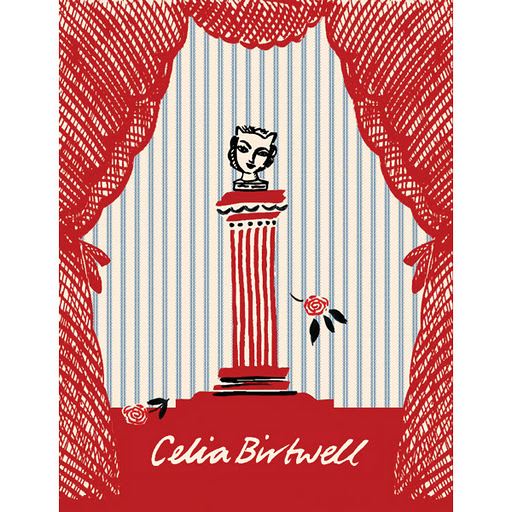
For Christmas I received a rather delightful book that I had wanted for a while the new book on Celia Birtwell. What I like about this book is that it is a real marriage between beautiful images of original garments, Celia’s prints and tales from the time. It gives you an insight into Celia’s life and also  helps you to better understand her prints. It not only gives an insight into her heyday in the late 60s and 70s but brings you right up to the present. For any print aficionado I cant recommend it highly enough.

I have a bit of a book obsession. This is my book shelf in my uni house. Almost all of these books are about fashion history with a few books dotted in about some of my other random obsessions too (graffiti, mid century typography Dali and Gaudi feature heavily)

What I also really liked was that it gave me a few more clues into the interesting links between Alice Pollock, Ossie Clark, Quorum and Radley. Which has been one of my big vintage obsessive research areas of the past six months.

Reading the book helped me to uncover something really interesting. This is the Celia prints on Radley dresses debate. Something that I’d long known about was that Ossie was fiercely protective over Celia’s designs and whilst designing for Radley Celia rarely produced any designs for Radley which were not on Ossie dress designs. Why therefore does the odd definite Celia print occur on Radley dresses without the magic Ossie name too?

Well, the book sheds some light on this Ossie stopped working with Radley in 1973 but Celia continued to work with Radley (producing 2 fabric collections a year) until 1976. It would appear therefore that those unmistakable Celia designs that are sometimes seen on Radley dresses without the accompanying Ossie name date between 73-76. Helping me to date my own lovely Celia Birtwell print dress.

The book helped me further with this dress too. Whilst I’m still not 100% sure of the exact print it is definitely one of her bouquet prints which were some of her most popular designs.
I love a good bit of fashion investigation, and I highly recommend purchasing this book too!

Nina Leen

I absolutely adore a good bit of vintage photography, and I am a massive Beatonophile (yep, I’m really that obsessed with Sir Cecil that I have a word for it : )) So imagine my glee today when I came across a midcentury photographer whom I had never come across before.
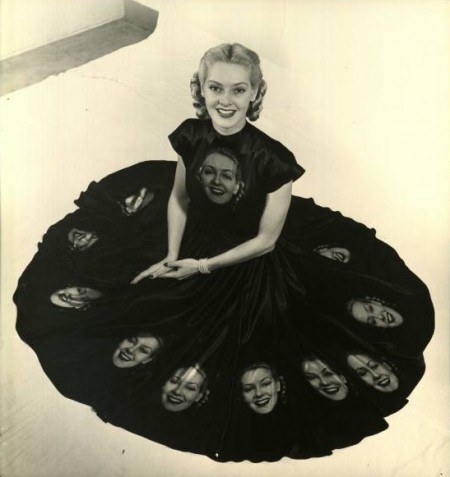
Today I introduce you to Nina Leen. Leen was a Russian born photographer who primarily worked for Life magazine in America. She was very well known for her animal photography but I’m most interested in her fashion shoots.  She started working for Life in 1945 producing over 40 covers for the magazine and countless other stunning shoots too! I love the way in which Leen organises her compositions very artfully done with a hint of quirkiness for good measure.

                           
                                 Look at these for novelty print circle skirts. Sigh. Want them all!

This beautiful lady comes from 1953. I adore her hat. 

Another dreamy dress from 1949
Candid shot of a home ec class possibly?

Matilda Etches: long forgotten couturier

I have a bit of a thing for long forgotten couturiers. Couture now is such a dying art and the couture system today is only a tiny proportion of what it once was. For example in France couture represented  a third of the countries G.D.P in the late 1940s. Yet today there are just 11 offical members of the Chambre Syndicale de la Haute Couture


Britain on the other hand has a very different couture legacy with couture houses often seeing their money made (unitl 1958 when presenting stopped) through debutante dresses. In Britian today  the couture industry has all but ceased to exest and those names who were once revered in a similar light to the French couturiers (for example Hardy Amies and Bianca Mosca) are often forgotten.
Today I would like to introduce you to a particular British couturier of note, Matilda Etches (sometimes seen as Matilda Ethces-Homan). Etches for reasons I will discuss later has a very important position in terms of the acceptance of fashion into the museum world.
Etches was famed throughout the 40s particularly for her fashionable yet innovative clothing that often featured careful sculptural detailing. I originally discovered her work when investigating garments using minimal seams. I then found this example of her work in the V and A collection. The jacket here can be worn either as seen in the image or worn the other way round to create a dramatic peplum. The jacket must have been created as a circle for this to be possible.
Etches though should be remembered for her pivotal position in terms of the Victoria and Albert museums acquisition  policy. Etches had two of her pieces (seen here) accepted into the V and A collection in 1969. The pieces “were shown to senior Museum officials as key acquisitions. They were the first modern fashion items to be accorded this honour” (V and A website)
From correspondence of Madeleine Ginsburg to Matilda Etches-Homan, letter written 9 June 1969, following acceptance of the Etches collection & dossier 

“The image of our 20th century costume collection has received a great boost through you! For the first time clothes from this century have been chosen to show the meeting of our advisory committee – a honour usually reserved only for medieval embroideries. They are to see the Butterfly cape and the West African cotton dress.”

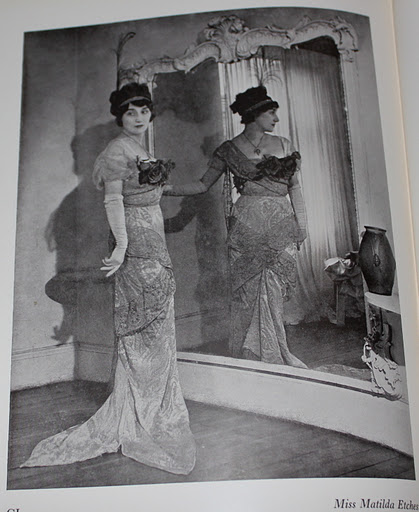
So all in all a pretty important lady in terms of British couture no doubt! I was also rather lucky to find two pictures of her. These are from the Doris Langley Moores book “the Woman in fashion” and see Etches posing in a dress from 1900(above) and 1913(top of post)
Moore used key people in fashion of the day for this book, so Ethces must have clearly been considered important enough in 1949 to be included!
(additional images from the V and A collections website)