Rae Spencer-Cullen and Miss Mouse: The beginning of the kitsch revival


This year I’ve decided to go back to my roots a bit more with more posts around fashion history. I’m going to aim for one informative post a week (lets see if I can actually keep up with this!). Last week I gave you Mariano Fortuny. This week Rae Spencer-Cullen.
Rae Spencer-Cullen was the designer of the fabulous Miss Mouse label. Miss Mouse is one of the first brands to really capture the spirit of the first 50s revival that hit in the early to mid 70s. This revival spirit was well documented in the recent Pop! Exhibition at the Fashion and Textile Museum. Spencer-Cullen was one of a small group of designers who were using the kitsch spirit of the 50s and re-inventing it for a modern audience.
Two Miss Mouse garments in the recent Pop! exhibition. 
 
I have two pieces of Miss Mouse clothing, which I think account for some of the most collectible items I own.
My two Miss Mouse dresses
 
This was the first Miss Mouse dress I purchased- and I believe accounts for her earlier label- definitely in use until 1974.
My dress dates to 1974-This is known as there is an example of the fabric in the Victoria and Albert museum.

The label found in the earlier examples of Miss Mouse garments

My second Miss Mouse dress

 The later Miss Mouse label
 
This is another example of a Miss Mouse dress in the Victoria and Albert museum which I think really exemplifies the kitsch spirit of the brand.
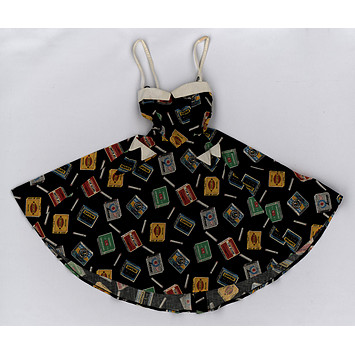
This dress- like mine also dates to 1974. The dates of these items are particularly fascinating, how do we know they categorically date to 1974? Well, the dress above and the fabric for my dress both featured in one of the Victoria and Albert museums first exhibitions to focus on contemporary fashion. The fabric of pop.
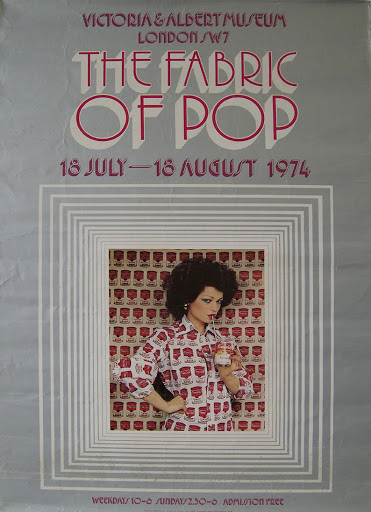
The original exhibition poster from The fabric of pop.

From the fabric of pop exhibition catalogue
“Pop Art’s influence on textile and fashion design owned all it’s inspiration and much of its success to our mass-produced urban culture. It found it’s full expression in the commercialism it poked fun at and came full circle by ending up on the pages of those glossy magazines that has originally proved pop art with much of its imagery.”
 
 
And just a few more examples of garments that featured in the Fabric of pop. I think you can see how the items in this exhibition show distinct similarities to those that featured in the recent exhibition at the Fashion an textile museum.
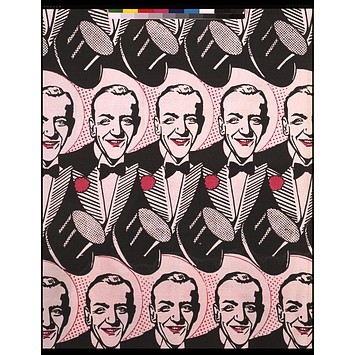
 

“Fred” fabric- 1973- Lloyd Johnson
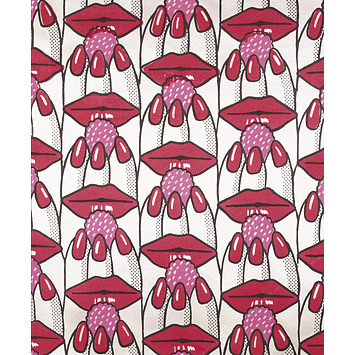
Raspberry lips fabric- Designed by Jane Wealleans for Ok textiles Ltd.- 1973

And now, back to Miss Mouse. Here are a few items of Miss Mouse clothing that particular captured both my imagination and the spirit of Spencer-Cullen’s design.
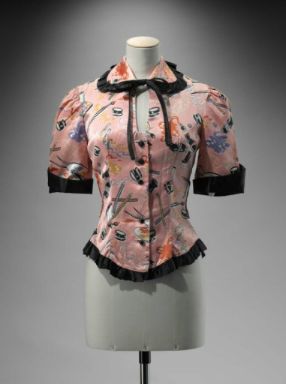
I’ve discovered that the museum of fine arts in Boston has the blouse version of my dress
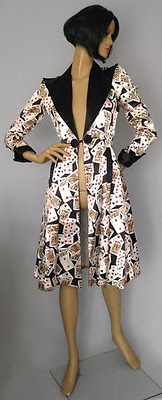
 This INSANELY fabulous coat, which actually matches my dress was sold by Liz Eggleston a few years ago, I remember the intense swooning over it at the time it was for sale.
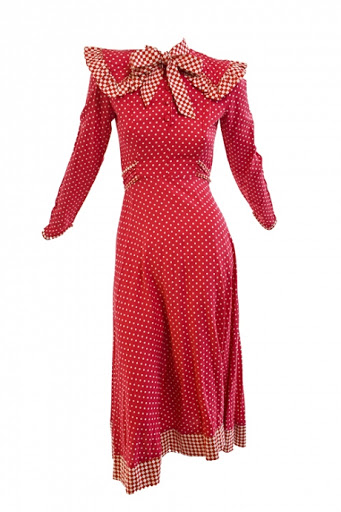

Fab red polka dot example. This red polka dot was a signature of Miss Mouse designs and often featured on the linings of Rae-Cullen’s garments.

This sensational and (less typical) example of Miss mouse comes from Manchester City galleries
dated 1973-76


According to a Glagow Herald article in 1976 Spencer-Cullen started designing her quirky pieces in 1970.
As the article suggests, to begin with “she was elusive, hazed in shadows, a real mouse about publicity in fact.  The only evidence of her existence was her clothes”
Her designs are described as “cheerfully schizophrenic”, which I think accurately captures the haphazard spirit with designs borrowed from the 50s but made entirely new.
“In summer her designs always seem especially right, breaking through winters dinginess to show off Lucy Locket pockets, drainpipe trousers in deckchair stripes, sweetheart necklines and shimmering raincoats”
I’m particularly interested by the “flowery skirts in cotton with detatchable lucy locket pockets” suggested in the article (I’ve never seen one of these but I’m guessing it is like a Dorothy bag). If anyone has come across a Miss Mouse example of this, please do let me know!
Spencer-Cullen was a young designer in the 70s. In 1976 she was just 29, suggesting that when she started her company she was a mere 23. Her spirit imagination and quirky spirit are all hugely appealing. Well known for having at periods her hair either crimson or emerald, she was an alternative designer yet was clearly highly commercial.
In 1976 Harpers Bazaar stated she was one of the “leading style innovators” and
West one magazine stated she (along with Vivienne Westwood) had the strongest style in London. Rae Spencer-Cullen certainly must have been a fashion force to reckon with.
(I’m going hunting for these issues as soon as my work load eases in the NAL)
Rae Spencer-Cullen and Duggie Fields. One of the few photos I could find of eponymous designer.

I’ll be honest- at the moment I’m struggling to find that much indepth information about the brand, but I’m currently contemplating writing about the 50s revival in the early 70s for my masters dissertation (along with about three million other topics that are floating around in my head) so watch this space for more information about the brand!
Additional information from:



The shoddy workmanship in a pair of high street trousers

This morning whilst getting dressed I pulled on a pair of printed Zara skinny trousers that I bought in late September this year. This was only the fourth time I had worn these and as I readjusted the pockets my hand went through them. AGAIN. I’ve often bemoaned the shoddy quality of high street goods but this pair of trousers really took the biscuit…I thought after some amazing purchases from Topshop (which I will blog about later this week) I had rekindled my love affair with the high street, but these trousers really angered me.
So here goes a tale into my sorry trousers.
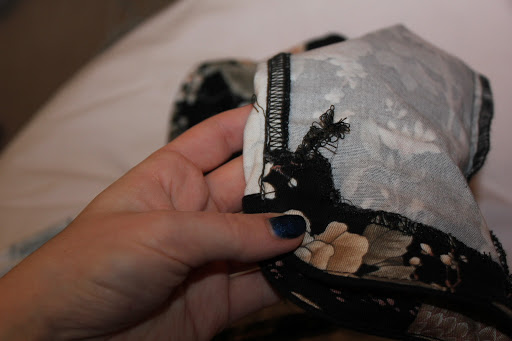
On the first wear my hand went through the first pocket (which I have since sewn up so I can’t show you the damage).
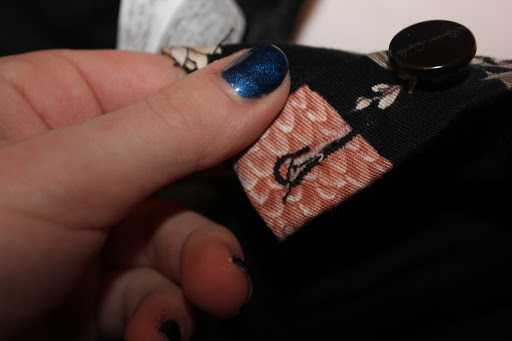
By the second wear the buttons on both the back pockets had fallen off.
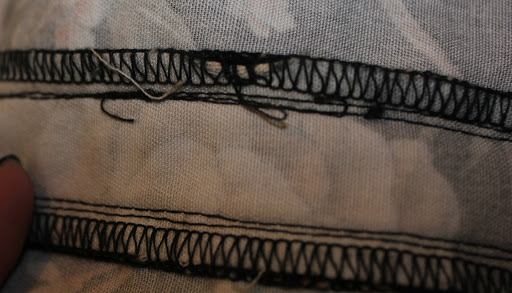
After this I decided to wash them- and this happened to the stitching around the button holes. It all came unraveled, so that I now have button slits rather than button holes.
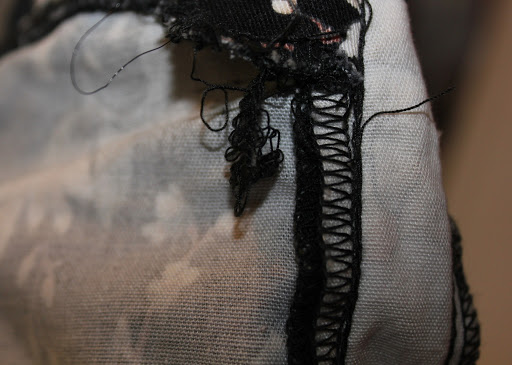
The cuffs at the bottom of the leg of one of the trousers also came completely unstitched.
 
And then, on my fourth wear my hand went through the other pocket.
Not only this, but the stitching on these trousers genereally is quite frankly shoddy.
 
(it’s not even like this could be backstitching to secure- this is right in the middle of the trouser leg)
How much effort does it take to cut off a bit of overlocking?
How difficult is it to stitch in a straight line?
 
After this incident (and considering my current addiction to high street printed trousers) I’ve vowed to look more closely at the workmanship before I purchase anything, because quite frankly after four wears for your trousers to be falling apart isn’t right. Paying £30 for a pair of trousers to be such poor quality? Not on Zara, not on at all.

Mariano Fortuny: Fashion as art

This morning whilst still feeling a little fuzzy headed (or rather fuzzy eyed as my eyes decided to have a hangover this morning) I was reminded of one of my all time favourite designers- Mariano Fortuny.

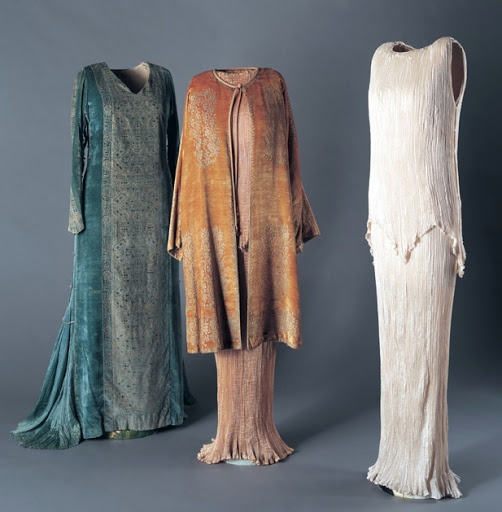
20s and 30s Fortuny dresses in the Arizona costume institute collection

Fortuny was one of the true fashion *geniuses* of the 20th century. Not only a talented designer he was a fantastic painter ( unsurprising as both his father and maternal grandfather were painters), sculptor and inventor, a man fascinated with technology. Between 1901 and 1933 Fortuny took out 22 patents, including one for his inventive pleating technique that he was so well known for in 1909.

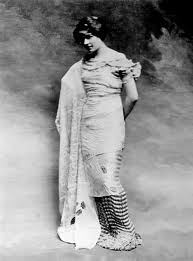
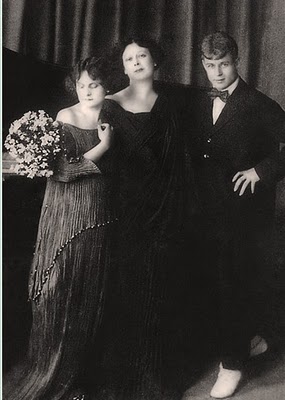
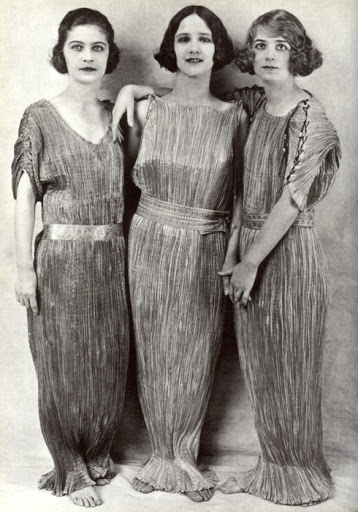
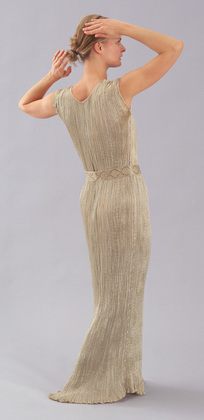
Fortuny’s most celebrated design is probably the Delphos which first appeared around 1907, like many of his pieces this was inspired by Greek drapery. It was originally designed as a “house” dress as it was  worn without a corset. Before long though avant garde women such as Isadora Duncan began wearing them outside the house and they became a popular item for more daring ladies. 

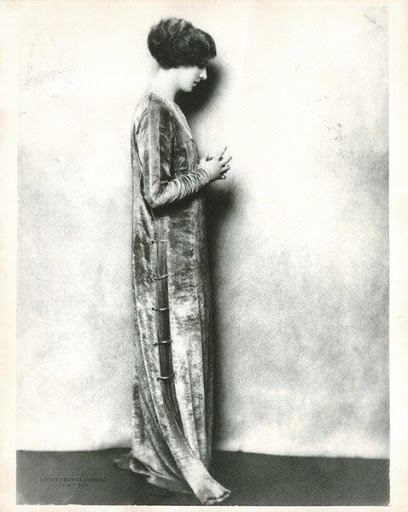
He is also well known for his velvet creations which were hand painted ans stencilled in his studio. Many of these pieces often take inspiration from medieval designs and have something of an ecclesiastical robes looks to them. He was also famed for his knossos scarf which was one of his first fashion creations.


Model with a Knossos scarf over a Delphos gown, 1909. 

Fortuny’s dresses allow the female form to speak to itself. Due to the springy pleats the dresses cling to the body, in a way that that when they were first introduced probably seemed indecent. Whilst Fortuny’s designs derived from antiquity he is often aligned with the rational/ artistic dress reformers whose ideas fitted with the style of his garments.


Fortuny’s wife Henriette in the studio

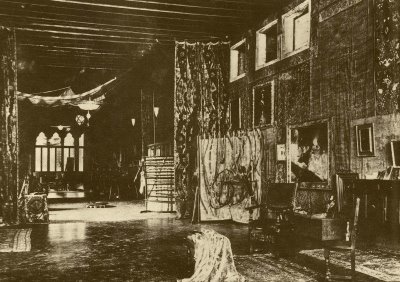
All of Fortuny’s designs were created at his house Palazzo Orfei in Venice. Despite being a Spanish designer Fortuny is often more closely aligned with this city where he spent his working life. The palazzo was a hub of creativity, as the images inside it testify. Here Fortuny worked alongside his wife Henriette who often assisted design and made up most of the dresses. Everything, bar the tiny venetian glass beads that were sewn onto the delphos dresses to weight them was made in their studio.

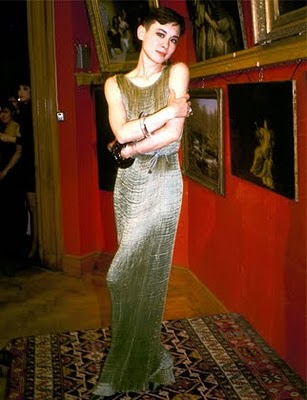
Fortuny’s dresses have something of a timeless appeal to them. Whatever period they have been worn in they still appear fresh and modern. Natalie Vodianova has (or rather had) two of these dresses, and still they look effortlessly elegant.


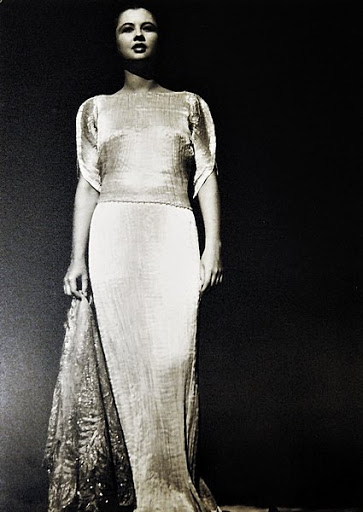
Here are a few of my favourite images of Fortuny dresses, I’ve tried to pick them from a wide ranging timescale to give an idea of the wearability of the dresses. 


Isadora Duncan in a delphos dress with her daughter

Duncans three adopted daughters (Lisa, Anna and Margot) in Delphos dresses c.1920


Tina Chow in a Fortuny dress ( i think this is an image from the 1980s)


Undated image of two Fortuny dresses- these show his skills in silk velvet. I think (due to hairstyles) these images are quite early. 


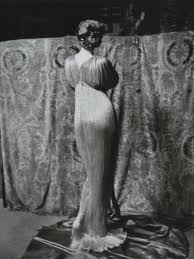
Woman wearing a Fortuny dress in the 1940s


Mrs. William Wetmore modeling a Delphos gown in front of Fortuny fabric. Originally published in Vogue, December 15, 1935


Countess Elsie Lee Gozzi wearing an Eleanora dress, 1920s.  


Autochrome of Selma Schubart c. 1908 by Alfred Steiglitz   


 Image of a Fortuny dress in the MOMA collection


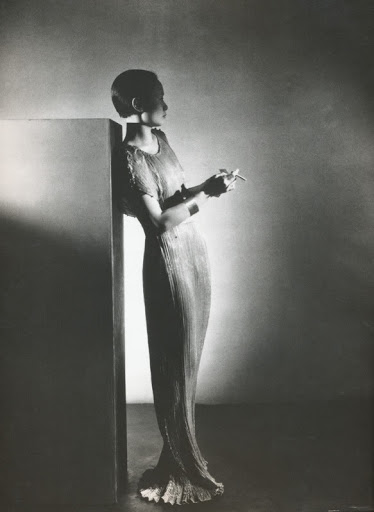
Mai-Mai Sze in a Fortuny gown, 1934. Photograph by George Platt Lynes. 

Incredible silk velvet Fortuny design


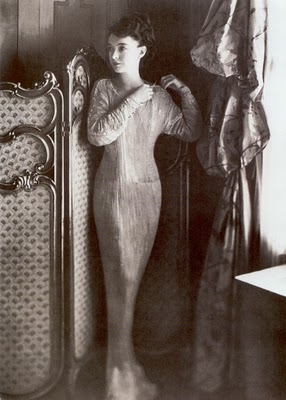
Lillian Gish in Fortuny 1920 


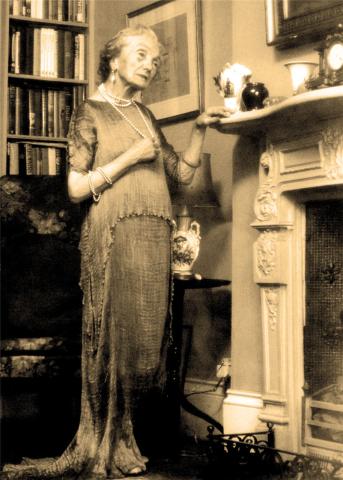
Elderly lady wearing a Fortuny dress. Undated but probably 1920s. 


 Marisa Berenson in a Fortuny dress for the Fashion: An Anthology exhibition catalogue 1971


Fortuny dress c 1915 


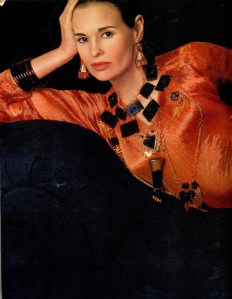
Gloria Vanderbilt in Fortuny 1969


Due to the fact that the dresses were designed to be kept twisted up in skeins they were the ultimate travel dresses. When they were first sold it must have been a liberating experience for a woman to have a dress that would travel so easily, and also require little care in respect of pressing.

As can be seen from these images Fortuny was perhaps more artist rather than designer. He was creating wearable art rather than fashion, and had no desire to be part of the fashion system and only gently tweaked his designs over the 40 years he was creating them. Fortuny dresses still command incredibly high prices, partly because Fortuny took the secret of his pleating process to the grave and it has never quite been replicated.

For a more in depth read on the Delphos dress I  highly recommend this blog from FIDM

http://blog.fidmmuseum.org/museum/2011/01/mariano-fortuny.html