Material World by Perri Lewis: A review

Last week I received a super exciting book through the post, “Material World” by Perri Lewis.
I’ll start off by saying I LOVE craft, but rarely have the time to indulge in making anymore. What I will say is even if you aren’t strictly a maker this book is pretty inspiring.  But most importantly I think it comes at it with a fresh angle, not twee, not whimsical, not pointlessly upcycled.  
It doesn’t contain loads of pointless crafty projects either, these are items you would actually want to make, and it got me thinking about items that would be great to make as gifts to save my pennies (being a poor student and all).
There are short overviews and “how-tos” for each craft before a more in-depth “project” is given. The instructions are all written in easy to follow plain English, with a little bit of humour thrown in too!
I also love the quirky little illustrations by Phil Lewis and Kate Wilson that run through it, and the final photographs of the pieces you can make are simply shot, and hint to the accessibility of each item in the book.
My favourite part? Definitely the master classes and insiders tricks that are littered throughout the book. There are tips by everyone from Emma Bridgewater to Rosie Woolfenden and Harriet Vine of Tatty Devine.
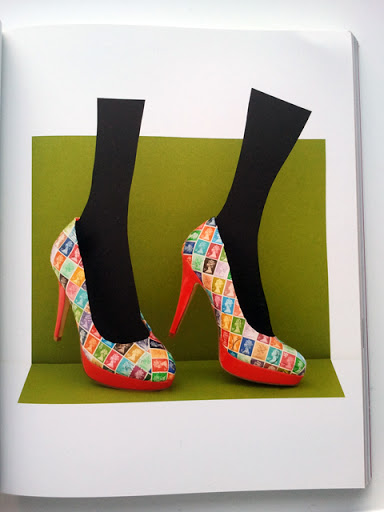
It feels more like a cookbook for crafts (I know that sounds like a funny thing to say…but it is) accessible to all, there are things from the simplest of projects that could be completed in a few hours to those that may take a few days (I desperately want to try the stamp decoupage shoes…watch this space incase I mysteriously find the time). It is something you can easily dip in and out of, take one “recipe” from, yet that one “recipe” might become a favourite you use time and time again.
I think my next thing to do is to loan this to my super crafty 13 year old cousin, and see what she might fancy making from it… I’m sure there will be something to catch her eye!
All in all a desirable and useful book. You can buy it here via amazon:
Women of the Bauhaus

Last week whilst in a lecture about the Bauhaus my lecturer mentioned that a fabulous thing to look at (if one was in need of a little procrastination time) was hair cuts of members of the Bauhaus.
So, can you guess what I’ve been doing today?


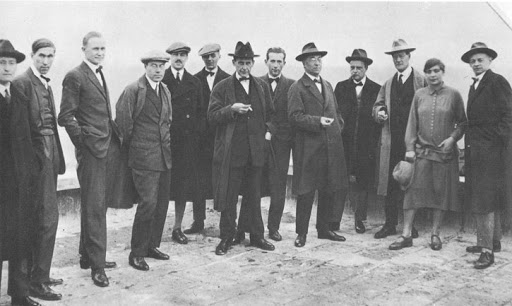
The Bauhaus masters in (I think) 1926

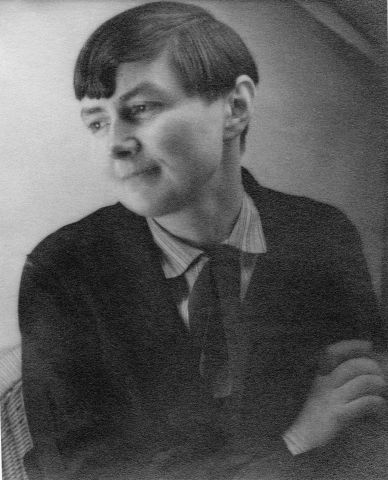
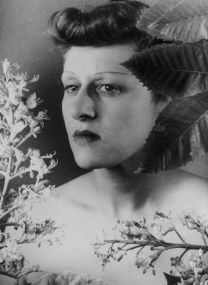
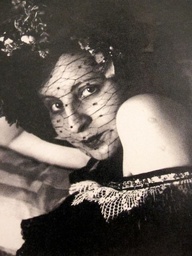
What fascinated me was not only the haircuts but the outfits too of these women. Some striking, some minimal, some simply modernist. Many of these women appear ahead of their time in terms of the style of their clothes and appearance.

The Bauhaus itself though has an interesting history, certainly in relation to women and its earliest years. The Bauhaus was, first and foremost, a design school and still today the concept of the “foundation year” that many students on design based courses take before their degree has its roots in the systems employed by the Bauhaus.  The Bauhaus begun under Walter Gropius in Weimar, Germany in 1919. Although by 1925 had moved to purpose built premises in Dessau. It is whilst the school was in Dessau that many of the women I share below were either students or teachers at the school.

The female perspective on the Bauhaus is one that intrigues me no end. The Bauhaus despite being a progressive school had a fraught relationship with women. Females were accepted as students, but few went on to receive the notoriety that male students of the Bauhaus did. The majority of female students focused their studies on weaving, i.e. traditional female craft rather than engaging in the more progressive design work that the Bauhaus became so well known for, in particular architecture. 

So today, lets look back and celebrate some of the women of the Bauhaus. I feel like I am doing them something of a dis-service by focusing on their appearance rather than their work, but I think this gives a good background into who the characters of the Bauhaus were- beyond the instantly recognisable figures of Gropius, Meyer and Van Der Rohe.

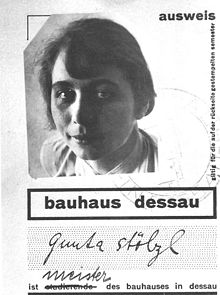
I’ll start with a few images of Gunta Stolzl who was one of the most important women of the Bauhaus for a number of reason.  Stolzl was the only female master at the Bauhaus (in its original German guise). She became the senior master of the weaving department in 1927. 
 
.
 
Gunta stölzl Tut schlemmer, Walter beck, Oskar schlemmer, 1926
 
“We wanted to create living things with contemporary relevance, suitable for a new style of life. Huge potential for experimentation lay before us. It was essential to define our imaginary world, to shape our experiences through material, rhythm, proportion, color, form.”
Gunta Stölzl, reflecting on her time at the Weimar Bauhaus in Bauhaus. Zeitschrift für Gestaltung, July 2, 1931
Benita Kock-Otte
 
 
Heinrich Koch, Portrait of Benita Koch-Otte, 1920s
Ilse Fehling
Unknown Photographer, Portrait Ilse Fehling, 1928, later print
 
Irene Bayer
 
Grit Kallin-Fischer, Portrait Irene Bayer, 1927/28
Karla Grosch
 
Marianne Brandt (?), Portrait Karla Grosch, Dessau c. 1928-29
 
Mariane Brandt
 
Self portrait
 
Self portrait 1929
Florence Henri
Lucia Moholy, Portrait Florence Henri, en face, 1927
 
Tulia Kaiser, Florence Henri, N.d.
Margaret Camilla Leiteritz
 
1931
Greta Stern
 
Grete Stern, Selbstportrait, 1935
Lis Beyer
20.2.1929
 
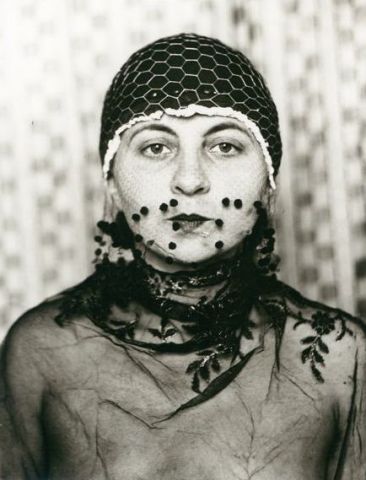
Gertrud Arndt
 
Gertrud’s series of “mask” portraits have to be amongst my favourite Bauhaus era photographs  Although not really recognised until the 1980s they playful images speak of Arndt’s preliminary interest in textiles (she had been a student in the weaving workshop of the Bauhaus).


Erich Consemüller, Marcel Breuer and his “harem” (from left to right: Marta Erps-Breuer, Katt Both and Ruth Hollos-Consemüller), c. 1927
 
 
Found this one via pintrest, so no details on it I’m afraid.


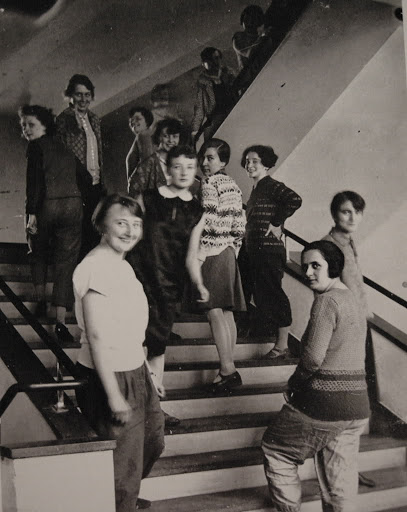
I’ll finish with this image of the Bauhaus women. This image features in the book:
 

Bauhaus Women: Art . Handicraft . Design

 
which I would highly recommend if you are interested in the topic. 

Valentino: Master of Couture at Somerset house

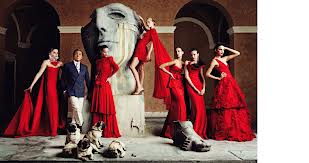
Last week I ventured to Somerset House to see the Valentino exhibition. I’m not the biggest fan of Valentino- I’m not sure why, but his designs simply have never really done it for me, too ostentatious and too Italian I suppose : /. Anyway, after hearing great things about the exhibition (in particular about its layout) I decided to take a visit.
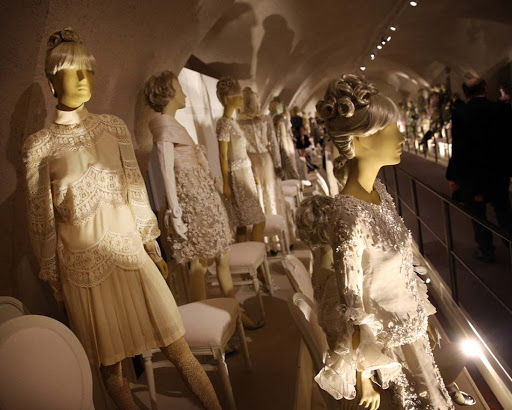
I have to say it was an hour well spent. The layout of the exhibition was superb, as I expected. The long tunnel in Somerset house helps to give the exhibition a very intimate feel, and the mannequin layout meant you were able to get relatively close to the dresses, and see all the details.
The mannequins too are fantastic, and very lifelike. It is great having the variety of seated and stood mannequins which gives a good understanding of the way the garments move with the body.
I particularly liked the Valentino garments from the 50s and 90s. I realised that much of my dislike for Valentino applied to his early 00s garments, although overall the embellishment and detail within each piece was jaw-dropping. You could really see the process of designer revisiting and re-inventing designs from his archive.
 The textile techniques downstairs at the exhibition really gave a clear view of how different details on the garments were made, and due to my own background in fashion design I couldn’t quite get over the sheer volume of work that must have gone into some of the dresses.
The wedding dress downstairs too, is just beautiful, so romantic, timeless and “intimate” (I know that’s a weird word to describe a dress…but that just conveys what I felt about it). I think this has to be the highlight of the exhibition, especially the way you walk up to it, almost as if you  are the groom, seeing the bride.
Complaints? For me, the details about the dresses were pretty scant, but  then again I like to leave an exhibition feeling like I’ve been educated. After leaving Valentino I felt like my eyes had been treated to beautiful things, but I didn’t really have a lot to say.
For example I was absolutely fascinated by the series of garments from 1990 which were originally designed in the 50s. I was desperate to know how, and why this came about… I think I’ll have to take a look at some of the Valentino books on offer for some more info.
I feel like this is a fashionistas exhibition rather than a fashion historians, but deeply enjoyable nonetheless.
Valentino: Master of couture is on at Somerset house until 3rd March.
Images all from the Somerset House facebook page.