Vintage photographs and magazines

This morning (hangover in tow) I took myself off to my favourite car boot sale at St Philomena’s high school in Carshalton, Surrey. The car boot wasn’t quite at its best, quieter than usual for sellers, although there were still some excellent bits and bobs to be found.

I bought nearly all of my goodies from one seller. The majority of my purchases were a stack of 1930s magazines (the seller had a RIDICULOUS number). But what I was really excited about was the three photographs I bought.

I always find it a bit weird buying old photographs, it is something that is so personal to someone and I always feel upset that people would not want to keep items such as this which hold such a close personal connection. My own family pictures that I have are amongst my most prized possessions. Especially the pictures of my Nanna Hazel in the 40s and 50s, who stands today as my inspiration in life.

My main reason for purchasing such pictures tend to be their clothes, but today only one was purchased on the base of the fashion. The other two ladies were just so hauntingly beautiful that they had to come away with me!

This is the first image. A 1930s one. To me with the big collars this appears to be very much mid 30s and fits in perfectly with some of the imagery in the magazines I picked up today which mostly date from the 33-35 period.
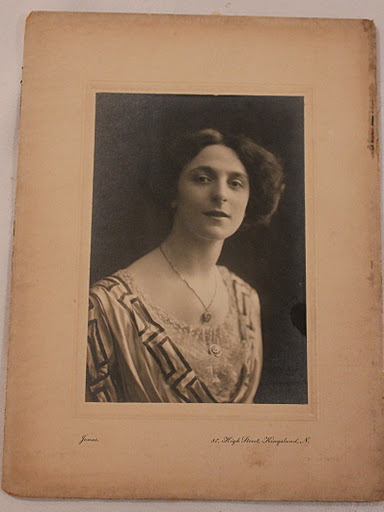
This is the second stunning lady. As you can only see a tiny hint of her dress it is very difficult to date accurately. I’m guessing this dates from the early 1910s, although without more of a picture it is difficult to tell. It is the bodice on this that is really saying that to me!


This is the last and my favourite, another lady who had to come with me. She is very much an unconventional beauty and the first thought when saw her was doesn’t she look like Jane Morris! Jane was the wife of the great Pre Raphaelite and arts and crafts artist William Morris. Jane was also the muse of Dante Gabriel Rosetti one of the founding members of pre-Raphaelite brotherhood. The painting this particularly reminded me of was Proserpine (1874) with Jane Morris’ luxurious waves of dark hair which are echoed in this image.

I really struggled with dating this image. To me it is quite a timeless one, but I did a little research on the photographers studio which the second and third image come from and found out that Alexander Jonas ran a photography studio at 87 high street Kingsland (Dalston) from 1906 to 1915. So I suppose it must date in between these two dates.

 
I did make a few other purchases too of jewellery and compacts but I thought these were far more interesting!
Schiap Schiap Hooray

Today I’m going back to my roots…sort of . What I am really doing is going back to a post which I wrote nearly 2 years ago. All the way back then I wrote about Schiaparelli who is my favourite designer of ALL time, today after doing a research project on 30s fashion I’m going back to the Schiap and I’ll introduce you to some of my favourite designs.
Schiaparelli was one of the most innovative and imaginative designers of the 1930s. She began here career as a fashion designer in the 1920s creating simple knitted jumpers with trompe l’oeil motifs, but it was really the 1930s when her career took off.
The 30s saw Schiaparelli take design inspiration from a wide variety of sources, from art to nature even the celestial sky became her inspiration. Schiaparelli was more than just a designer she created objects d’art and Balenciaga would later say she was. “ the only true artist in fashion”
Schiaparelli was an innovator in terms of fabric and design, bringing the zip fastening to high fashion and often creating gowns in unusual fabrics. She often used synthetics to create her luxurious evening gowns.
Her style came to epitomise a new woman who was developing. Schiaparelli created “power dressing” before the term was even invented. She began developing more of a military silhouette in the 1930s with boxy shoulders and a squared silhouette that would become mainstream fashion in the 40s. Her clothing oozed sex appeal at a time when this still was often seen as inappropriate using motifs which had hidden sexual meaning.

Wonderful example from the Pagan collection featuring the insect buttons which came to epitomise this collection.
Schiaparelli’s circus collection of 1938 was one of her most popular and whimsical. The theme was widely copied.
The circus collection was launched in February 1938, Schiaparelli “sent the performers skipping up and down the imposing staircase and leaping on and off the venduses’ desks in her dignified showroom…This was the most riotous and swaggering show that fashion had ever seen. Here you paraded in a tall hat and a ringmaster jacket with a high collar, or in tights worn under long narrow black skirts.”

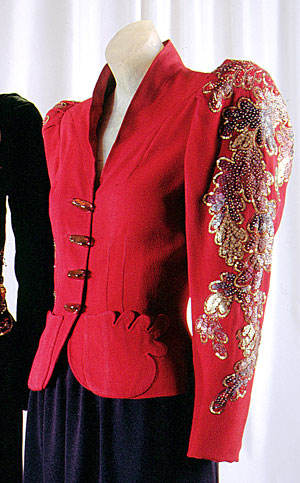
This is the jacket I originally blogged about all that time ago, which I now understand in a lot more depth than previously, and it still stands to be the garment I would probably give up my entire vintage collection for (o.k. everything bar my Horrockses, they are my babies after all). It was one of the key pieces in the Circus collection and the image here shows Maria Berenson, Granddaughter of Schiaparelli wearing the jacket (it is is the actual jacket in the V & A) for a Vogue shoot in 1971. The jacket actually featured in Cecil Beaton’s exhibition of the same year for the V& A Fashion: An Anthology which was the dawning exhibition of a new age of fashion exhibitions.

The fastenings on the jackets are one of the most important parts of the Circus collection. These complex fastenings employ industrial techniques, Here industrial slide hooks are used to keep the cast metal buttons in place.

The tear dress is probably one of Schiaparelli’s most famous designs. This piece was created for the 1938 Circus collection in collaboration with Dali. The dress uses imagery based on Dali’s painting necrophiliac springtime. The pink and red painted design is supposed to resemble torn flesh. The dress is typical of Schiaparelli’s playful juxtaposition of beautiful dresses with seemingly odd print or embroidery subject matter. 


The theme of Schiaparelli’s 1939 fall collection was music. This is one of the key garments from the collection. The dress is embroidered with musical notes in jaunty colours with gloves to match. The collection also featured fanciful items such as buttons shaped like drums and music boxes on hats. Many of the embroideries covering her garments this season featured instruments and musical notes.


And a final note, one of the key inspirations throughout Schiaparelli’s career was the 1890s. She collaborated on a series of wonderfully whimiscal printed dresses with Vertes and often the shapes of her garments recall the period (leg-o-mutton sleeves anyone). So whilst Schiaparelli was a great innovator she was more than happy to borrow from history too! The image above comes from 1939,  The print on the middle dress is an example of one by Vertes, there are a number of further fabulous examples in the book Fashion and Surrealism too.

Valentina: A forgotten legend

So, I’m currently knuckling down hard to final year work. But when I came across the image above I rediscovered a designer I simply couldn’t RESIST but write about, the designer in question is Valentina.
As part of one of my themes this year I am working on trying to use as few seams as possible in my designs. Whilst searching this on Google I stumbled across Valentina, a designer I had heard of but completely forgotten about (and no this isn’t me misspelling Valentino!)
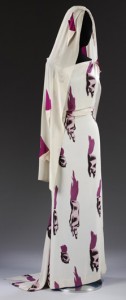
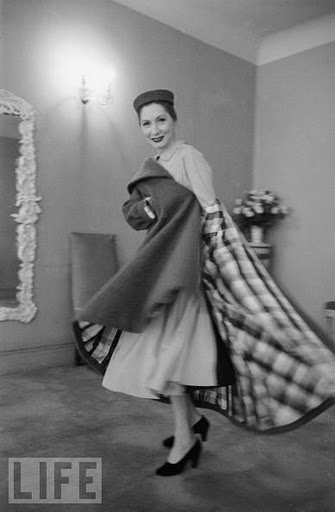
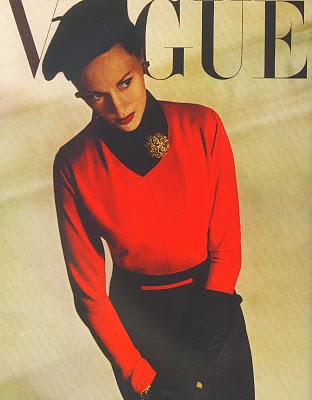
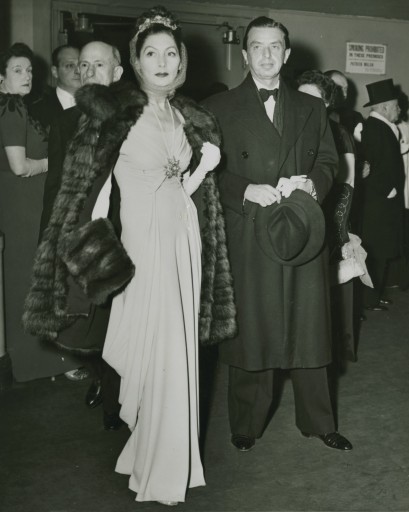
Valentina was  a Russian emigree. Her full name was Valentina Nicholaevna Sanina Schlee but she went by the name “Valentina”. She went to America to pursue a career in dance, but without speaking English this proved to be very difficult. She then chose to puruse a career in looking glamorous, or modeling as one might say! Valentina was undoubtedly an exotic beauty as these pictures prove.
Valentina is a designer of great interest as she was working at a time when Paris totally dominated couture, yet she was working in America and receiving renown for a similar design style to that in Paris (interesting at a time when America was really trying to forge its only distinct style away from the look dictated by Paris) She was the first “celebrity” couturiers in the U.S.A , becoming as renowned as the celebrities she dressed. One of the women whom she dressed was Greta Garbo, who infact had an affair with her husband George Schlee. She was the first designer to really promote the idea of “persona over product” herself appearing on the cover of American Vogue to promote her clothes.
Her work is similar to the likes of Vionnet and Madam Gres. Especially in the 1930s she focused heavily on bias cut and garments which were almost moulded to the body. Looking at her garments from this period you can see the superior construction used. She created often quite simply cut garments but they were always executed to the highest of standards. The look was quite minimalistic without being too basic. The smallest of seemingly insignificant details tended to turn her dresses into something fantastic. I particularly love these two dresses which feature revealing sections. Whilst the 1930s was undoubtedly the decade of the back these show off different areas which would have probably seemed quite daring in the 30s.
What I find fascinating also is the price of her clothes, even in the late 40s her clothes cost between $800 to $1,200 a piece. Her designs were those which event he wealthy would have had to save up for!  Valentina made couture garments in the true sense of couture. Her dresses were really made to fit the wearer, often she would ignore their wishes and chose to make garments which she knew would suit them. She stated, “clothes have little independent existence of their own.” Valentina made her garments so that they enhanced the wearer, and it was clear that the lady was wearing the clothes rather than the other way around.
This is a quotation from her which I really liked and is  very inspiring for my current work;
“To simplify a dress, I make as few seams as possible. And I am forever standing away looking at it, asking myself what I can take away from it rather than what I can add to it.”
She also often designed ensembles which could fit a wide range of sizes. These normally were  created with waist ties which meant the wearer could determine the exact look they wanted for the ensemble. She tended to create garments which were without padding or boning. Her clothes were essentially “unstructured” so that they could mould to the wearer.
For anyone interested to find out more about the designer there is a book Valentina: American Couture and the Cult of Celebrity. The image here is from the exhibition which the book accompanied.
Most of these images come from the Met Museum website, do take a look, some fantastic images available!