A dreamy Alice Pollock dress

Alice and Ossie


Anyone who knows me knows that I rarely foray into fashion past the early 1960s, but there are a few designers for whom I will make an exception. One of these is Alice Pollock. I feel that Pollock is still quite an underrated designer yet she discovered one of the best design talents of the second half of he 20th century so really deserves to be celebrated more ! (commands high prices, without the level of respect she deserves is what I mean)
Pollock is probably best known for her boutique Quorum which she set up in 1964. Not only was she a wonderful designer herself, but she had an excellent knack for spotting the latest design talent. Quorum is probably best known for the desiger Ossie Clark. Clark started working for Pollock in 1966 after she spotted his designs and ordered a selection of dresses for the Quorum boutique. At the time she was buying dresses from Ossie for £10 a batch (imagine Ossies for £10) The early Ossie garments for Quorum (1966) were mostly plain floaty pieces in cream or white chiffon.  It was Pollock who apparently pushed Ossie Clark to work with Celia Birtwell (apparently she wanted a more organic feel for the designs).
Typically of the swinging sixties though the Quorum brand reached trouble (business management was not either Clark or Pollocks forte- they regularly gave away pieces or they simply disappeared). I’ve found contrasting information as to when exactly Pollock sold out Quorum to Radley. (Some sources say 1967 others 1969) although I think they were receiving some financial backing for sure form 1967 onwards.
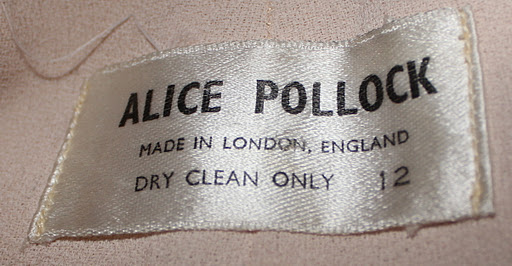
So why the all the info about Alice Pollock? It’s all because of this dress. Which I am infact selling at the moment on my ebay here.

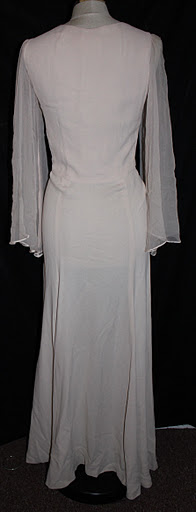
 What I particularly love about this is its rouleau loop fastening (something Clark began experimenting with in 1967) it really is a glamorous feature that calls to mind the deco designs of the 30s that were so inspiring designers in the late 60s and early 70s.
I love the quality of the moss crepe too. Another thing which calls to mid older vintage dresses, it really is a beautifully made piece, I can totally see it being appropriate as a wedding dress!
The dress is an absolute dream to wear (I swanned about in it for a good 15 minutes before telling myself, no you can’t keep it you need to sell it, sob). It really does cling to you in a way that the dresses  by this “set” can- Pollock and Ossie Clark mostly although I did once try on a Thea Porter dress that made me feel just as wonderful.
As you can probably tell I’ve attempted to do my research into the designs of Alice Pollock and I am a little bit stumped by this, it is difficult to give an exact date, although I have seen very similar pieces by her dating to 1973, so I would take a stab that this is an early 70s piece.

All in all a lovely piece. What I am intrigued about is when did Alice Pollock actually dissapear as a designer? I think the latest Pollock I’ve ever seen is 1974…the mind boggles.
A wonderful little blouse


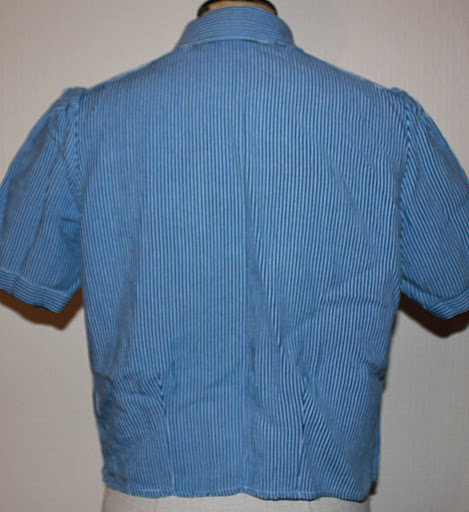
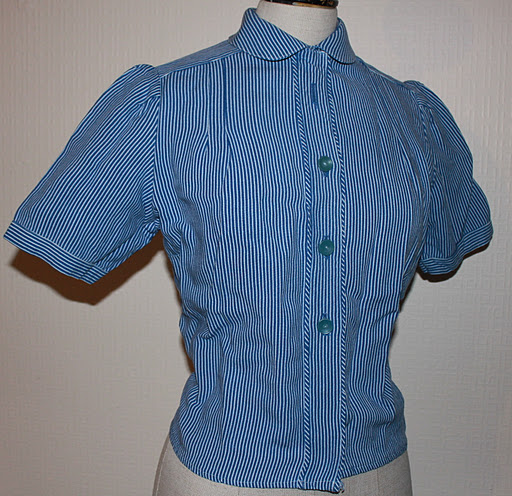
Today I am dedicating my blogpost to one little item. On first glance you are probably thinking it’s just a simple blue and white striped blouse. A vintage item most probably (this is me after all and it is highly unlikely to be modern), but this blouse is much more than it at first appears and also helps to tell a story about an important period in Britain’s fashion history.
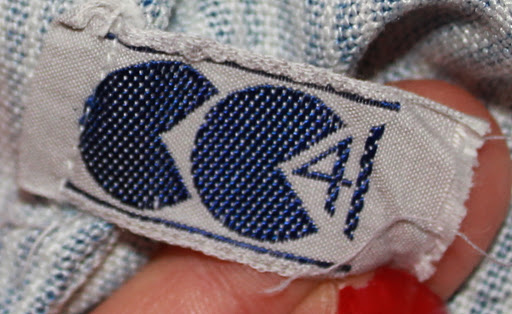
There is one small label sewn into the side seam of this blouse which makes all the difference: A cc41 label. What I really like about this blouse is that it shows so many of the restrictions in one item.
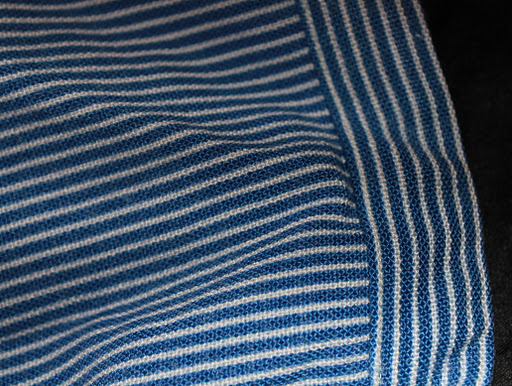
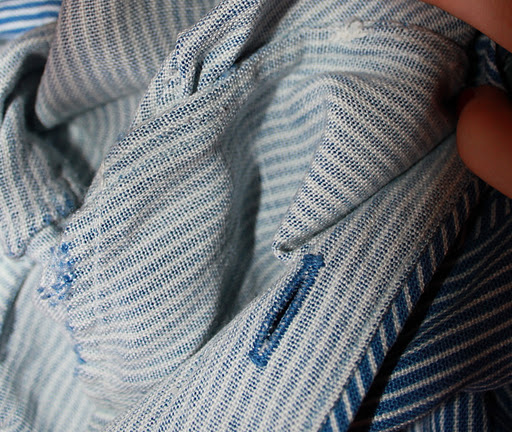
First off (although difficult to tell by my picture) the blouse is really quite short. Now whilst the length of a blouse was not rationed many manufacturers made garments that were designed to be tucked in to quite a short length to save on fabric. When looking inside the blouse you can also see how tiny the hem is, again a fabric saving device. All of the seams in the blouse have very small seam allowances as is illustrated in the pictures, and again was a necessary fabric saving device.

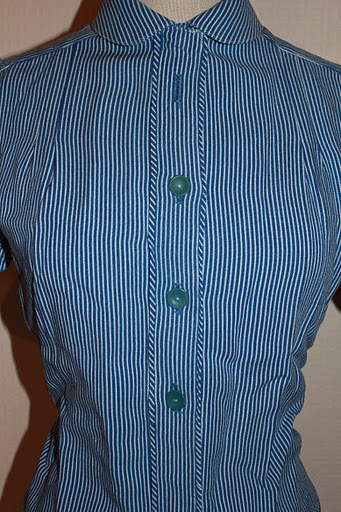
Next is the collar (I’m a sucker for a Peter pan collar any day of the week). One of the rulings under utility was that a collar could be no deeper than 5” as illustrated here, this is a very short collar!

If you look at the sleeves you can see how they have been made to look like turnback cuffs, yet the “turnback” is actually a strip of fabric stitched on as turnbacks cuffs where strictly prohibited. The sleeves also do not have any buttons- this would make it easier to get into the blouse, but restrict the amount of buttons that could be used elsewhere, hence why there aren’t any.
I think the most canny part of the blouse though is the centre front button fastening. Under Utility restrictions a blouse with full length sleeves could have up to 7 buttons, whilst one with short sleeves was restricted to just 5. This blouse originally had just four (currently 3 as one is missing) and the rest of the blouse fastens with poppers. Two at the bottom of the blouse and one for security at the neckline. I feel that the ones at the bottom of the blouse actually act as a really good design feature, if you are tucking the garment in you would not have the added bulk from the button showing through your skirt.
And, whilst researching into utility I also found out something rather interesting about the manufacturers labels themselves, they could have “no more than one name tab and one drop ticket in addition to the size tab and utility label.” This blouse has its manufacturer label and then details about the fabric “moygashel” on the same label. It is interesting to consider how in 40s garments these details would often be on two separate labels, but under the utility restrictions only one label could contain all of these details. The smaller label underneath is the utility design no. which all utility items should have.
And on another note some may be wondering what is this mystery fabric moygashel? It is a particular type of linen fabric from the area of Moygashel in Ireland, it is quite a strong hard wearing fabric and was particularly popular during the 40s 50s and 60s before falling out of favour. I have to say that the vintage moygashel garments I have come across all seem to be particularly hard wearing and also they retain their colours rather well.
The label also states that it has “tubernised fused parts” (it too me a while to work out what this word actually said) basically this was a finish that helped garments to look “fresh and clean all day” and reduced the need to starch or boil your garments (in particular this finish was used for men’s starched collars.
So all in all a very interesting little blouse, and what is even better. I am selling it! Find it over on my ebay here. I’m selling a lot in the next few weeks and months including some amazing vintage Biba and Alice Pollock, so do keep having a look.
If you want to know more about Utility check out some of the restrictions here, http://cargocultcraft.com/knowledge/wartime-austerity-restrictions-on-british-clothing/womens-and-girls-wear-dresses-jumpercardigan-suits-blouses-skirts-and-slacks/ it really is an invaluable resource. Or, have a look at my previous post on the topic here.

Mrs Exeter: One hell of a stylish lady

Today I am going to introduce you tone of my favourite fictional characters, Mrs Exeter. Anyone who has read Vogue magazines from the 50s may recognise this name, but who was Mrs Exeter and what did she do for fashion?
Mrs Exeter helped bring the older woman to the forefront of fashion in the 1950s. The character first appeared in 1949  ‘Approaching 60, Mrs. Exeter doesn’t look a day younger, a fact she accepts with perfect good-humour and reasonableness’ she confesses to a 33-inch
waist, disappearing eyebrows, and a yellowing complexion as well as her rheumatism!”
 Initially the character was an illustration by Audrey Lewis, it wasn’t until 1952 that photographs of the character actually appeared. The original Mrs Exeter was played by a Mrs Eastley who was a similar age to the character of Mrs Exeter. Mrs Eastley had lived a similar late Victorian upbringing as the character, where values such as poise and elegance were key and a woman was nothing without good posture. It is interesting also how slim the character was in the first photographic representations (33in waist, no way, more like 23in). It wasn’t until 1954 that the person most associated with Mrs Exeter, Margot Smyly, began to play her. Interestingly Margot Smyly was only in her thirties when she began to represent her. Vogue still suggested that Mrs Exeter was in her sixties, despite the younger model being used. If I were a model I don’t know how happy I would feel about representing a character 30 years older than myself!
The 1950s were one of the few periods in fashion when an older woman could look chic and at the height of fashion without looking overdone. The styles of the 1950s (full skirts, etc) could be quite forgiving for the older woman, and it was a period where many young girls were dressing almost to look like their mothers. This had a lot to do with Dior’s own ideal image of a woman: his mother. Mrs Exter came to be the epitome of this older yet still impeccably stylish woman.
As a character Mrs Exter helped to show that fashion was appropriate for all ages, and featured regularly in “Clothes with no age-tag” It is interesting that in these features it is often Mrs Exeter who looks more comfortable in the clothes rather than the younger woman.
Mrs Exeter continued to appear in Vogue until the 1960s. Towards the end veering from a lady in her 60s to one who was only at middle age. It was mostly due to the changing fashions and an increasing focusing on youth fashions the character ceased to appear.
I wish that this idea of the older model was still seen in magazines and the like (I am a big fan of Twiggy in the now finished M&S adverts as cheesy as they were). Most representations of the older woman in fashion seem to be done in a “look how novel and politically correct we are being” manner, which simply isn’t necessary. Mrs Exeter was a very popular character and demonstrates why the 50s were such a great period of fashion, clothes to suit any age group. I think she is a great person to look to when more mature ladies now are thinking about wearing vintage clothing, the 50s styles definitely look great on women of any age!

(Mrs Exeter looking particularly youthful!)
I only wish I had more pictures to show, I only have a few copies of 50s Vogue and she does not feature in any of them!