Today I’m going back to my roots…sort of . What I am really doing is going back to a post which I wrote nearly 2 years ago. All the way back then I wrote about Schiaparelli who is my favourite designer of ALL time, today after doing a research project on 30s fashion I’m going back to the Schiap and I’ll introduce you to some of my favourite designs.
Schiaparelli was one of the most innovative and imaginative designers of the 1930s. She began here career as a fashion designer in the 1920s creating simple knitted jumpers with trompe l’oeil motifs, but it was really the 1930s when her career took off.
The 30s saw Schiaparelli take design inspiration from a wide variety of sources, from art to nature even the celestial sky became her inspiration. Schiaparelli was more than just a designer she created objects d’art and Balenciaga would later say she was. “ the only true artist in fashion”
Schiaparelli was an innovator in terms of fabric and design, bringing the zip fastening to high fashion and often creating gowns in unusual fabrics. She often used synthetics to create her luxurious evening gowns.
Her style came to epitomise a new woman who was developing. Schiaparelli created “power dressing” before the term was even invented. She began developing more of a military silhouette in the 1930s with boxy shoulders and a squared silhouette that would become mainstream fashion in the 40s. Her clothing oozed sex appeal at a time when this still was often seen as inappropriate using motifs which had hidden sexual meaning.
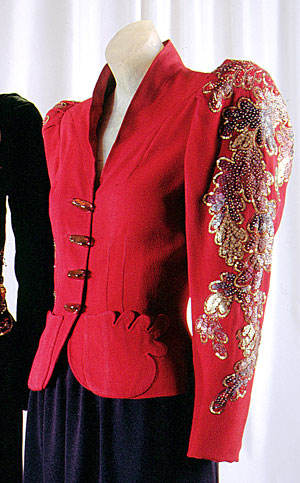
Wonderful example from the Pagan collection featuring the insect buttons which came to epitomise this collection.
Schiaparelli’s circus collection of 1938 was one of her most popular and whimsical. The theme was widely copied.
The circus collection was launched in February 1938, Schiaparelli “sent the performers skipping up and down the imposing staircase and leaping on and off the venduses’ desks in her dignified showroom…This was the most riotous and swaggering show that fashion had ever seen. Here you paraded in a tall hat and a ringmaster jacket with a high collar, or in tights worn under long narrow black skirts.”


This is the jacket I originally blogged about all that time ago, which I now understand in a lot more depth than previously, and it still stands to be the garment I would probably give up my entire vintage collection for (o.k. everything bar my Horrockses, they are my babies after all). It was one of the key pieces in the Circus collection and the image here shows Maria Berenson, Granddaughter of Schiaparelli wearing the jacket (it is is the actual jacket in the V & A) for a Vogue shoot in 1971. The jacket actually featured in Cecil Beaton’s exhibition of the same year for the V& A Fashion: An Anthology which was the dawning exhibition of a new age of fashion exhibitions.
The fastenings on the jackets are one of the most important parts of the Circus collection. These complex fastenings employ industrial techniques, Here industrial slide hooks are used to keep the cast metal buttons in place.
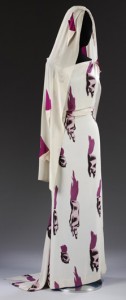
The tear dress is probably one of Schiaparelli’s most famous designs. This piece was created for the 1938 Circus collection in collaboration with Dali. The dress uses imagery based on Dali’s painting necrophiliac springtime. The pink and red painted design is supposed to resemble torn flesh. The dress is typical of Schiaparelli’s playful juxtaposition of beautiful dresses with seemingly odd print or embroidery subject matter.

The theme of Schiaparelli’s 1939 fall collection was music. This is one of the key garments from the collection. The dress is embroidered with musical notes in jaunty colours with gloves to match. The collection also featured fanciful items such as buttons shaped like drums and music boxes on hats. Many of the embroideries covering her garments this season featured instruments and musical notes.

And a final note, one of the key inspirations throughout Schiaparelli’s career was the 1890s. She collaborated on a series of wonderfully whimiscal printed dresses with Vertes and often the shapes of her garments recall the period (leg-o-mutton sleeves anyone). So whilst Schiaparelli was a great innovator she was more than happy to borrow from history too! The image above comes from 1939, The print on the middle dress is an example of one by Vertes, there are a number of further fabulous examples in the book Fashion and Surrealism too.



 Advantage In Vintage