Today I am very happy to share one of the most interesting articles I have dug up during my research thus far, a piece from the 1961 issue of Woman and Beauty entitled “Presenting Frederick Starke”. This article was one of a short series running from March 1961 (Window on Fashion by Anne Barrie) onwards that profiled some of the key ready-to-wear fashion houses operating in London at the time. I have tracked down the whole series via the British Library and will be sharing them all (in full!) over the coming weeks. As Starke is the main protagonist of my PhD research though, I thought I would start with him. I will say as an aside- Starke was prone to a little bit of elaboration of the truth we might say, so some of the things he said may be best taken with a pinch of salt 😉
As part of my research I would love to hear from anyone who knew Starke, worked for his companies OR even wore his clothes. Please feel free to email me: liztregenza@hotmail.com
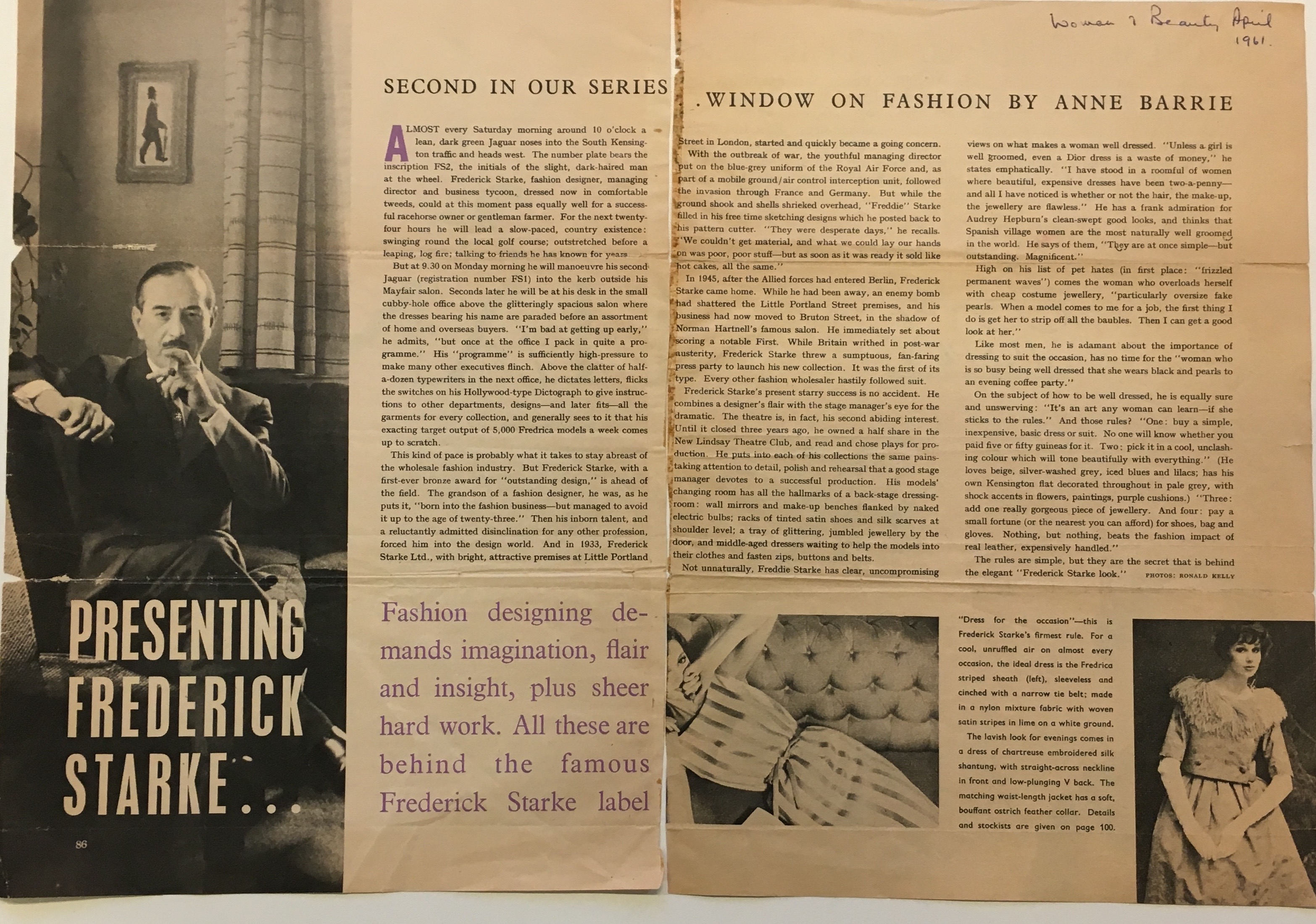
Presenting Frederick Starke Woman and Beauty April 1961
Almost every Saturday morning around 10 o’clock a lean, dark green Jaguar noses into the South Kensington traffic and heads west. The number plates bears the inscription FS2, the initials od the slight, dark haired man at the wheel. Frederick Starke, fashion designer, managing director and business tycoon, dressed now in comfortable tweeds, could at this moment pass equally well for a successful racehorse owner or a gentleman farmer. For the next twenty-four hours he will lead a slow-paced, country existence: swinging round the local golf course; outstretched before a leaping, log fire; talking to friends he has known for years.
But at 9.30 on Monday morning he will manoeuvre his second Jaguar (registration number FS1) into the kerb outside his Mayfair salon. Seconds later he will be at his desk in the small cubby hole office above the glitteringly spacious salon where the dresses bearing his name are paraded before an assortment of home and overseas buyers. ‘I’m bad at getting up early,” he admits, “but once at the office I pack in quite a programme.” His “programme” is sufficiently high-pressure to make many other executives flinch. Above the clatter of half-a-dozen typewriters in the next office, he dictates letters, flicks the switches on his Hollywood-type Dictograph to give instructions to other departments, designs-and later fits- all of the garments for every collection, and generally see to it that his exacting target output of 5,000 Fredrica models a week comes up to scratch.
This kind of pace is probably what it takes to stay abreast of the wholesale fashion industry. But Frederick Starke with a first-ever bronze award for ‘outstanding design”, is ahead of the field. The grandson of a fashion designer, he was, as he puts it, “born into the fashion business- but managed to avoid it up to the age of twenty-three.” Then his inborn talent, and a reluctantly admitted disinclination for any other profession, forced him into the design world. And in 1933. Frederick Starke Ltd., with bright, attractive premises at Little Portland Street in London, started and quickly became a going concern.
With the outbreak of war, the youthful managing director put on the blue-grey uniform of the Royal Air Force and, as part of a mobile ground/air control interception unit, followed the invasion through France and Germany. But wile the ground shook and shells shrieked overhead, “Freddie” Starke filled in his free time sketching designs which he posted back to his pattern cutter. ‘They were desperate days” he recalls. “We couldn’t get material, and what we could lay our hands on was poor, poor stuff- but as soon as it was ready it sold like hot cakes, all the same.”
In 1945, after the Allied forces had entered Berlin, Frederick Starke came home. While he has been away, an enemy bomb had shattered the Little Portland Street premises and his business has now moved to Bruton Street, in the shadow of Norman Hartnell’s famous salon. He immediately set about scoring a notable First. While Britain writhed in post-war austerity Frederick Starke threw a sumptuous, fan faring press party to launch his new collection. It was the first of its type. Every other fashion wholesaler hastily followed suit.
Frederick Starke’s present starry success is no accident. He combines a designers’ flair with the stag manger’s eye for the dramatic. The theatre is, in fact, his second abiding interest. Until it closed three years ago, he owned a half share in the New Lindsay Theatre Club, and read and chose plays for production. He puts into each of his collections the same painstaking attention to detail, polish and rehearsal that a good stage manager devotes to a successful production. His models’ changing room has all the hallmarks of a back-stage dressing room: wall mirrors and make-up benches flanked y naked electric bulbs; racks of tinted satin shoes and silk scarves at shoulder level; a tray of glittering, jumbled jewellery by the door, and middle-aged dressers waiting to help the models into their clothes and fasten zips, buttons and belts.
Not unnaturally, Freddie Starke has clear, uncompromising views on what makes a woman well dressed. “Unless a girl is well groomed, even a Dior dress is a waste of money,” he states emphatically. ‘I have stood in a roomful of women where beautiful, expensive dresses have been two-a-penny- and all I have noticed is whether or not the hair, the make-up, the jewellery are flawless.” He has a frank admiration for Audrey Hepburn’s clean-swept good looks, and thinks that Spanish village women are the most naturally well groomed in the world. He says of them, “They are at once simple- but outstanding. Magnificent”
High on his list of pet hates (in first place: ‘frizzled permanent waves”) comes the woman who overloads herself with cheap costume jewellery, “particularly oversize fake pearls. When a model comes to me for a job, the first thing I do is get her to strip off all the baubles. Then I can get a good look at her.”
Like most men, he is adamant about the importance of dressing to suit the occasion, has no time for the “woman who is so busy being well dressed that she wears black and pearls to an evening coffee party.”
On the subject of how to be well dresses, he is equally sure and unswerving: :It’s an art any woman can learn- if she sticks to the rules.” And those rules? One: buy a simple, inexpensive, basic dress or suit No one will know whether you paid five or fifty guineas for it. Two: pick it in a cool, unclashing colour which will tone beautifully with everything.” (He loves beige, silver-washed grey, ice blues and lilacs; has his own Kensington flat decorated throughout in pale grey, with shock accents in flowers, paintings, purple cushions.) “Three: add one really gorgeous piece of jewellery. And four: pay a small fortune (or the nearest you can afford) for shoes, bag and gloves. Nothing, but nothing, beats the fashion impact of real leather, expensively handled.”
The rules are simple but they are the secret behind the elegant “Frederick Starke look.”
“Dress for the occasion”- this is Frederick Starke’s firmest rule.
Fashion designing demands imagination, flair and insight, plus sheer hard work. All these are behind the famous Frederick Starke label.

 Advantage In Vintage